Three Stars In The South
A rare bullish reversal pattern in a downtrend.
Visual Example
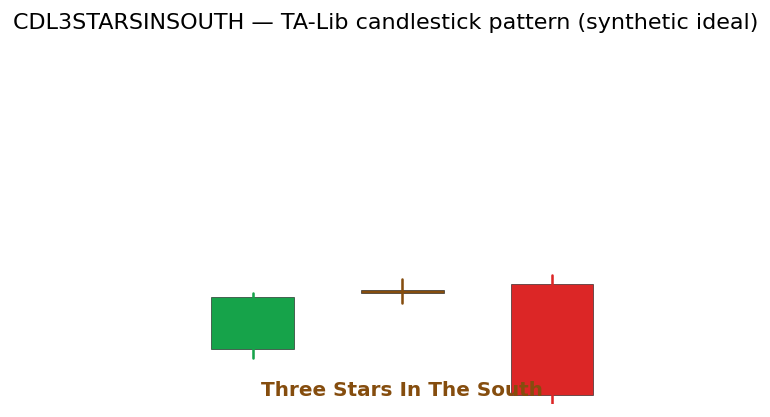
Synthetic ideal per library logic. Generated 2026-07-01 IST via docs/generate_all_previews.py (reproducible; maps to core Next<T> implementation).
Description
A rare bullish reversal pattern in a downtrend.
Indicates a gradual exhaustion of selling pressure.
QuantWave evaluates this pattern on completed OHLC windows using TA-Lib-aligned geometry rules. Output is an event signal (+100 bullish, −100 bearish, 0 none) — ideal for rule-based strategies and encoded ML features.
Typical applications:
- Scan for completed pattern windows — never act on partial formations
- Combine with Market Structure or trend filters in production
- Encode signed output (+/−/0) before ML training
- Expect false positives in choppy ranges; require volume or HTF confirmation
QuantWave implements this via the universal Next<T> trait — bit-identical across Rust streaming, Python streaming, and Polars .ta() batch plugins.
Formula / Specification
Recognition Rules (TA-Lib-compatible, CDL3STARSINSOUTH in quantwave-core/src/indicators/pattern.rs):
- Stateless candlestick pattern evaluated on OHLC windows.
- Returns a signed signal (+100 bullish, −100 bearish, 0 none) on the completion bar.
- Exact threshold geometry (body ratios, gap requirements, shadow lengths) matches the TA-Lib reference implementation wrapped via
talib_cdl!inquantwave-core/src/indicators/pattern.rs. - Validate against
quantwave-core/tests/gold_standard/vectors where present.
Parameters
| Parameter | Default | Description |
|---|---|---|
| (none) | — | No tunable parameters for this detector. |
Usage Examples
Streaming (Rust)
use quantwave_core::indicators::CDL3STARSINSOUTH;
use quantwave_core::traits::Next;

let mut det = CDL3STARSINSOUTH::new();
for (o, h, l, c) in &ohlcv {
    let sig = det.next((o, h, l, c));
}
Streaming (Python)
from quantwave import CDL3STARSINSOUTH

det = CDL3STARSINSOUTH()
for o, h, l, c in ohlcv:
    sig = det.next((o, h, l, c))
Polars Batch (Python)
import polars as pl
import quantwave  # registers pl.col().ta

df = (
    pl.read_csv('ohlcv.csv')
    .lazy()
    .with_columns(
        pl.col("open").ta.cdl_3starsinsouth("open", "high", "low", "close").alias("three_stars_in_the_south")
    )
    .collect()
)
All surfaces are bit-identical via the single Next<T> implementation and proptests.
Edge Cases & Limitations
- Requires sufficient complete OHLC bars; early bars yield no signal.
- False positives are common in sideways markets — gate with trend or structure filters.
- Pattern semantics follow TA-Lib body/shadow rules; literature variants may differ.
- Signed output (+/−/0) should be consumed as events, not continuous features without encoding.
- Combine with volume expansion or higher-timeframe confirmation for production use.
- No look-ahead bias; signal is known only after the pattern window closes.
Boundary Behavior
| Condition | Behavior |
|---|---|
| Warm-up | Leading bars return NaN until warmup_bars is satisfied. |
| period > len | When period exceeds series length, output is all NaN. |
| NaN inputs | NaN in input propagates to output (NaN out). |
| Invalid params | Non-positive period or missing required params raise ValueError. |
| Empty data | Empty input returns an empty result series. |
Related Indicators & See Also
Sources & References
Primary Source: https://www.investopedia.com/articles/active-trading/062315/using-bullish-candlestick-patterns-buy-stocks.asp
Implementation: quantwave-core/src/indicators/pattern.rs (CDL3STARSINSOUTH / CDL3STARSINSOUTH_METADATA).
Pattern reference: TA-Lib CDL family via talib_cdl! in pattern.rs. Nison (1991) cited for psychology only — no duplicated boilerplate.
Parity: quantwave-core/tests/gold_standard/cdl3starsinsouth.json
Provenance: Standards bulk upgrade 2026-07-01 IST — see docs/DOCUMENTATION_STANDARDS.md.