Fractional Differentiation
Applies Prado-style fractional differencing to preserve memory while reducing non-stationarity in price series.
Visual Example
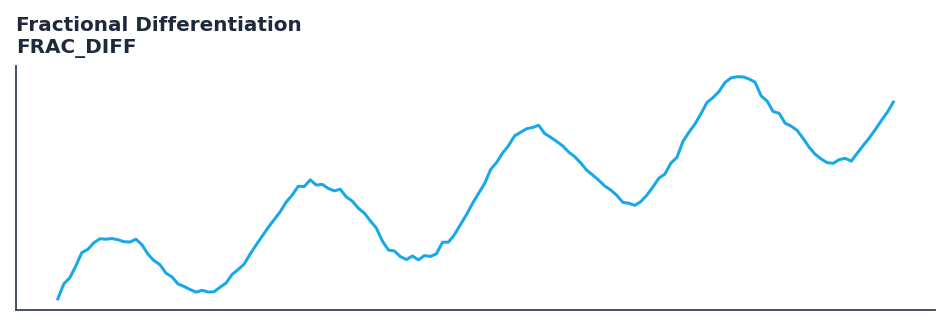
Synthetic ideal per library logic. Generated 2026-06-28 IST via docs/generate_all_previews.py (reproducible; maps to core Next<T> implementation).
Description
Fractional differentiation transforms a price or return series into a partially stationary feature while preserving long memory — the key insight from Marcos López de Prado's Advances in Financial Machine Learning. Integer differencing (d=1) removes autocorrelation but erases predictive structure; raw levels (d=0) are non-stationary. Fractional order d ∈ (0,1) sits between those extremes.
Practitioners typically apply this to log-prices or cumulative returns before tree models, neural nets, or cross-sectional factor research. Lower d (0.3–0.5) keeps more history in each bar; higher d approaches a first difference. The threshold parameter truncates the weight tail so the convolution window stays finite and streaming-friendly.
Compared to ad-hoc rolling z-scores or winsorization alone, frac-diff is a principled stationarity transform with a published weight recurrence. Pair with regime filters (Hurst, HMM) when building ML feature matrices.
QuantWave implements this indicator via the universal Next<T> trait, guaranteeing bit-identical results between Rust streaming, Python streaming, and Polars batch (.ta.frac_diff()) surfaces.
Formula / Specification
Implementation (frac_diff):
Gold-standard parity vectors: quantwave-core/tests/gold_standard/frac_diff.json.
Parameters
| Parameter | Default | Description |
|---|---|---|
d |
0.4 | Fractional differentiation order (0 = identity, 1 = full integer diff) |
threshold |
1e-5 | Truncate weights when |
Usage Examples
Streaming (Rust)
use quantwave_core::indicators::FracDiff;
use quantwave_core::traits::Next;

let mut ind = FracDiff::new(0.4, 1e-5);
for price in &prices {
    let value = ind.next(price);
}
Streaming (Python)
from quantwave import FracDiff

ind = FracDiff(0.4, 1e-5)
for price in prices:
    value = ind.next(price)
Polars Batch (Python)
import polars as pl
import quantwave as qw  # registers LazyFrame.ta when using quantwave-polars plugin

df = (
    pl.read_csv('ohlcv.csv')
    .lazy()
    .ta.frac_diff("close", 0.4, 1e-5)
    .collect()
)
All surfaces are bit-identical via the single Next<T> implementation and proptests.
Edge Cases & Limitations
- Warm-up: output is NaN until the full weight window fills (length depends on
dandthreshold; e.g. d=0.4, threshold=1e-5 may require 200+ bars). - Very small
thresholdincreases window length and memory; very largethresholdtruncates weights early and may under-difference. doutside [0,1] is clamped; d=0 approaches identity, d=1 approaches integer differencing.- NaN inputs propagate NaN output for that bar; do not forward-fill before frac-diff without documenting bias.
- Sudden gaps or bad ticks distort the weighted sum — winsorize or filter outliers on illiquid names.
- Validated via proptests and
quantwave-core/tests/gold_standard/frac_diff.json. - No look-ahead bias; streaming and Polars batch paths are bit-identical.
Boundary Behavior
| Condition | Behavior |
|---|---|
| Warm-up | Leading bars return NaN until warmup_bars is satisfied. |
| period > len | When period exceeds series length, output is all NaN. |
| NaN inputs | NaN in input propagates to output (NaN out). |
| Invalid params | Non-positive period or missing required params raise ValueError. |
| Empty data | Empty input returns an empty result series. |
Related Indicators & See Also
Sources & References
Primary Source: https://www.wiley.com/en-us/Advances+in+Financial+Machine+Learning-p-9781119482086
Implementation: quantwave-core/src/indicators/frac_diff (FracDiff / _METADATA).
Parity: quantwave-core/tests/gold_standard/frac_diff.json
Provenance: Standards bulk upgrade 2026-06-28 IST — see docs/DOCUMENTATION_STANDARDS.md.