SuperTrend
Uses the EMA-smoothed Atr, not Wilder's ATR
SuperTrend's bands are built on QuantWave's Atr, which smooths true range with an EMA
(alpha = 2/(period+1)) rather than Wilder's RMA (alpha = 1/period, SMA-seeded)
used by TA-Lib and TradingView Pine's ta.atr. Band width — and therefore where the trend flips — can differ from a TradingView SuperTrend on identical inputs.
No source has been recorded for the EMA smoothing — the formula_source recorded
for this indicator describes the Wilder-based construction. See Average True Range for the full
surface-by-surface breakdown, and quantwave.conventions("supertrend") to read the
divergence programmatically.
ATR-based trend follower that doubles as a trailing stop — one of QuantWave's flagship indicators and the steel-thread reference for batch ↔ streaming parity.
Visual Example
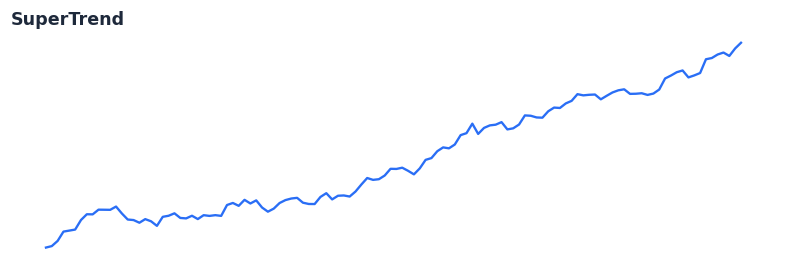
Synthetic OHLCV with SuperTrend line and direction flips. Generated via docs/generate_all_previews.py; maps to the core Next<(f64,f64,f64)> implementation.
Description
SuperTrend overlays a volatility-adjusted band on price and tracks whether the market is in an uptrend or downtrend. When trend is up, the active line sits on the lower band (support); when trend is down, it sits on the upper band (resistance). A close beyond the opposite band flips direction — producing discrete, rule-based entries and exits without repainting past bars.
Production teams use SuperTrend for:
- Trend gating — only take long signals when
direction > 0 - Dynamic stops — exit when price closes through the active band
- Feature engineering — distance-to-SuperTrend and direction as ML inputs
- Backtest signals — feed
directioninto.bt.backtest()as exposure (see Strategy Backtest)
QuantWave implements SuperTrend through the universal Next<T> trait. The Polars expression plugin, Python streaming class, and Rust streaming struct all call the same core logic, validated by gold-standard vectors and streaming-batch proptests.
Formula / Specification
Source: TradingView — SuperTrend by Mobius
Let \(m_t = (H_t + L_t) / 2\) (bar midpoint), \(\text{ATR}_t\) the Wilder ATR over period, and multiplier the band width.
Final bands ratchet (never loosen against the prior bar):
Direction flips when price closes through the inactive band; the SuperTrend value is the active band:
Implementation: quantwave-core/src/indicators/supertrend.rs (SuperTrend::next((high, low, close)) → (value, direction)).
Gold-standard vectors: quantwave-core/tests/gold_standard/supertrend_10_3.json (period=10, multiplier=3.0).
Parameters
| Parameter | Default | Description |
|---|---|---|
period |
10 | ATR lookback length |
multiplier |
3.0 | Band width in ATR units; higher = wider bands, fewer flips |
Typical ranges: period 7–14 for intraday, 10–20 for daily; multiplier 2.0–4.0. Tighter settings increase whipsaws; wider settings increase lag.
Usage Examples
Polars batch (recommended)
import polars as pl
import quantwave  # registers pl.col().ta

df = (
    pl.read_csv("ohlcv.csv")
    .lazy()
    .with_columns(
        pl.col("close")
        .ta.supertrend("high", "low", period=10, multiplier=3.0)
        .alias("st")
    )
    .with_columns(
        pl.col("st").struct.field("supertrend").alias("supertrend"),
        pl.col("st").struct.field("direction").alias("supertrend_dir"),
    )
    .collect()
)
Streaming (Python)
import quantwave as qw

st = qw.streaming_class("supertrend")(period=10, multiplier=3.0)
for row in df.iter_rows(named=True):
    out = st.next(row["high"], row["low"], row["close"])
    # out.value → SuperTrend line, out.direction → +1 / −1
Streaming (Rust)
use quantwave_core::indicators::supertrend::SuperTrend;
use quantwave_core::traits::Next;

let mut st = SuperTrend::new(10, 3.0);
for (high, low, close) in bars {
    let (line, direction) = st.next((high, low, close));
}
Backtest wiring
signal_df = df.with_columns(
    pl.when(pl.col("supertrend_dir") > 0).then(1.0).otherwise(0.0).alias("signal")
)
report = signal_df.lazy().bt.backtest_with_report(signal="signal")
All surfaces are bit-identical via the single Next<T> implementation and proptests.
Edge Cases & Limitations
- Warm-up: First
periodbars build ATR state; early values follow core warmup semantics (see Boundary Behavior). - Whipsaws: Ranging markets produce frequent direction flips — combine with higher-timeframe trend or Market Structure filters.
- Gaps: Overnight gaps can trigger immediate flips; consider execution delay in backtests (
execution_delay="next_bar"). - Parameter sensitivity: Lower
multiplierorperiodincreases noise; higher values increase lag. - No look-ahead: Direction is known only after the bar closes; safe for live streaming and batch features.
Boundary Behavior
| Condition | Behavior |
|---|---|
| Warm-up | Leading bars may return partial ATR state until period bars are seen. |
period > series length |
Output reflects insufficient data; parity tests use explicit vectors. |
| NaN in H/L/C | NaN propagates to output for that bar. |
| Invalid params | Non-positive period or multiplier raise ValueError. |
Related Indicators & See Also
- ATR Trailing Stop — alternative ATR-based exit
- Keltner Channels — envelope bands with similar volatility scaling
- Parabolic SAR — complementary stop-and-reverse system
- Strategy Backtest notebook — SuperTrend →
.btE2E - Indicator Gallery
Sources & References
Primary source: TradingView — SuperTrend by Mobius
Implementation: quantwave-core/src/indicators/supertrend.rs (SuperTrend / SUPERTREND_METADATA)
Parity: quantwave-core/tests/gold_standard/supertrend_10_3.json; streaming-batch proptest in supertrend.rs