Relative Strength Index (RSI)
Wilder's momentum oscillator — the most widely deployed mean-reversion and divergence tool in systematic trading.
Visual Example
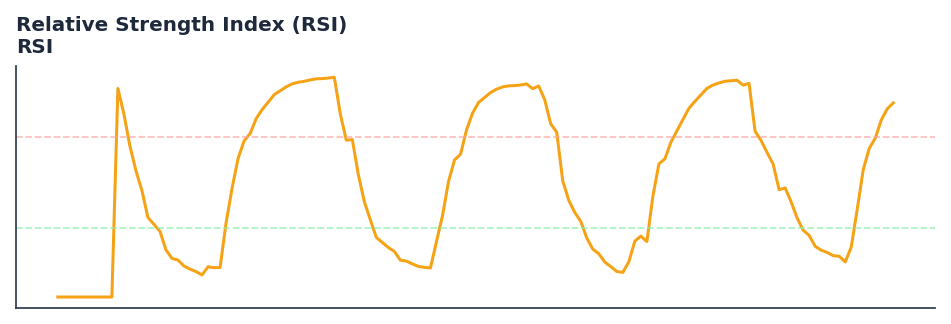
Synthetic price with RSI(14) panel. Generated via docs/generate_all_previews.py; maps to core Next<f64> implementation.
Description
RSI measures the ratio of average gains to average losses over a lookback window, scaled to 0–100. Values above 70 are traditionally overbought; below 30 oversold — though production systems often calibrate thresholds per asset and regime.
Common uses:
- Mean-reversion entries — fade extremes when higher-timeframe trend agrees
- Divergence detection — price makes new high while RSI does not (bearish divergence)
- ML features — stationary bounded oscillator; pairs well with Hurst and regime labels
- Signal gating — only take longs when RSI recovers from oversold in an uptrend (SuperTrend direction > 0)
QuantWave implements Wilder-smoothed RSI via Next<f64>, bit-identical across Rust streaming, Python streaming, and the Polars .ta.rsi() plugin. Validated against TA-Lib parity proptests and rsi.json gold-standard vectors.
Formula / Specification
Source: J. Welles Wilder, New Concepts in Technical Trading Systems (1978)
For each bar, compute price change \(\Delta_t = C_t - C_{t-1}\). Separate gains and losses:
Wilder smoothing (same recurrence as ATR):
Implementation: quantwave-core/src/indicators/incremental/rsi.rs (re-exported from momentum.rs).
Gold-standard vectors: quantwave-core/tests/gold_standard/rsi.json.
Parameters
| Parameter | Default | Description |
|---|---|---|
timeperiod |
14 | Wilder lookback length |
Shorter periods (7–9) react faster but whipsaw in ranges; longer (21–25) smooth noise at the cost of lag.
Usage Examples
Polars batch (recommended)
import polars as pl
import quantwave  # registers pl.col().ta

df = (
    pl.read_csv("ohlcv.csv")
    .lazy()
    .with_columns(
        pl.col("close").ta.rsi(14).alias("rsi"),
        (pl.col("close").ta.rsi(14) < 30).alias("oversold"),
    )
    .collect()
)
Streaming (Python)
import quantwave as qw

rsi = qw.streaming_class("rsi")(timeperiod=14)
for price in closes:
    value = rsi.next(price)  # 0–100
Streaming (Rust)
use quantwave_core::indicators::RSI;
use quantwave_core::traits::Next;

let mut rsi = RSI::new(14);
for price in &closes {
    let value = rsi.next(*price);
}
Backtest wiring (mean-reversion sketch)
signal_df = df.with_columns(
    pl.when(pl.col("rsi") < 30).then(1.0)
    .when(pl.col("rsi") > 70).then(0.0)
    .otherwise(None)
    .forward_fill()
    .alias("signal")
)
Edge Cases & Limitations
- Trending markets: RSI can remain overbought/oversold for extended runs — use trend filters, not raw levels alone.
- Warm-up: First
timeperiodbars build Wilder state; early values follow core warmup semantics. - Flat markets: Zero average loss → RSI defined as 100 in Wilder convention.
- Divergence is visual: Automating divergence requires swing detection — consider Market Structure for structure-aware logic.
Boundary Behavior
| Condition | Behavior |
|---|---|
| Warm-up | Leading bars return NaN until timeperiod samples accumulated. |
timeperiod > series length |
Insufficient data → NaN outputs. |
| NaN in close | NaN propagates through the rolling window. |
| Invalid params | Non-positive timeperiod raises ValueError. |
Related Indicators & See Also
- Laguerre RSI — Ehlers low-lag alternative
- Stochastic Oscillator — range-based momentum cousin
- Chande Momentum Oscillator — unsmoothed sensitivity variant
- ML Feature Stability notebook
- Indicator Gallery
Sources & References
Primary source: Wilder (1978); Investopedia RSI
Implementation: quantwave-core/src/indicators/incremental/rsi.rs (RSI / RSI_METADATA)
Parity: TA-Lib proptest in momentum.rs; gold-standard rsi.json