Gravestone Doji
A Doji variant with a long upper wick, a very small body located near the low of the range, and little or no lower wick. It represents a rejection of higher prices and carries bearish implications when appearing after an advance.
Visual Example
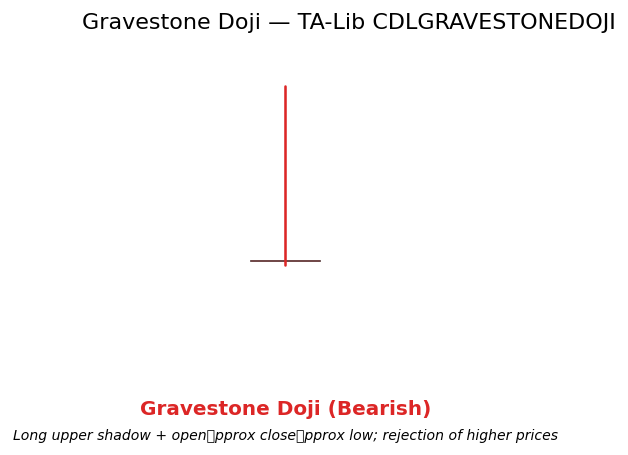
Synthetic ideal matching TA-Lib CDLGRAVESTONEDOJI logic (long upper shadow + open\approx close\approx low). Generated 2026-05-31 IST via docs/gen_candle_previews.py.
Description
The Gravestone Doji forms when buyers push price significantly higher during the period but are unable to sustain the advance; price collapses back to the opening level by the close. The long upper shadow visually records the failed attempt to move higher.
It is most meaningful after a sustained up-move or at resistance. Alone it is still only a warning; confirmation on the subsequent bar (close below the Gravestone low) materially increases its reliability. Quant developers frequently use it as a sparse directional feature in models that already contain Market Structure bias or ATR-based volatility regime.
Formula / Specification
Recognition Rules (exact implementation in QuantWave / TA-Lib CDLGRAVESTONEDOJI):
- Body length = |close − open| is negligible (Doji condition).
- Upper shadow (high − max(open, close)) is long relative to body and range.
- Lower shadow (min(open, close) − low) is negligible or zero.
- The pattern is identified when the above geometry holds; output follows TA-Lib sign convention (+100 / −100 / 0).
- Stateless single-bar test after OHLC history buffering in the streaming wrapper.
Parameters
| Parameter | Default | Description |
|---|---|---|
| (none) | — | Pattern recognition only; no tunable parameters. |
Usage Examples
Streaming (Rust)
use quantwave_core::indicators::CDLGRAVESTONEDOJI;
use quantwave_core::traits::Next;

let mut g = CDLGRAVESTONEDOJI::new();
for (o, h, l, c) in &ohlcv {
    let sig = g.next((o, h, l, c));
    if sig < 0.0 { /* bearish gravestone context */ }
}
Streaming (Python)
from quantwave import CDLGRAVESTONEDOJI
g = CDLGRAVESTONEDOJI()
for o, h, l, c in ohlcv:
    sig = g.next((o, h, l, c))
Polars Batch (Python)
df.lazy().with_columns(
    pl.col("open").ta.cdl_gravestonedoji("open", "high", "low", "close").alias("gravestone")
).collect()
Bit-identical across surfaces.
Edge Cases & Limitations
- Requires a completed bar; first bar yields no signal.
- Can appear in strong uptrends without reversal follow-through (continuation risk).
- Very low range bars distort the "long shadow" perception; combine with ATR.
- TA-Lib tolerance for "long" vs. body is reference-implementation specific.
- Highest value when the prior trend was up and the pattern occurs at a known resistance or structure level.
- Confirmation on next bar strongly recommended; isolated Gravestones in chop are low-value.
Boundary Behavior
| Condition | Behavior |
|---|---|
| Warm-up | Pattern functions emit 0 (no pattern) until enough bars exist. |
| period > len | Short series returns all zeros (no pattern detected). |
| NaN inputs | Bars with NaN OHLC are treated as no pattern (0). |
| Invalid params | N/A for most candlestick patterns. |
| Empty data | Empty input returns an empty integer series. |
Related Indicators & See Also
- Doji, Dragonfly Doji, Shooting Star, Inverted Hammer
- Market Structure for bias and resistance context
- S/R Interactions
- Gallery, native patterns index, PA notebook examples
Sources & References
Primary Source: TA-Lib CDLGRAVESTONEDOJI (ta-lib.org) wrapped in quantwave-core/src/indicators/pattern.rs.
Visual: docs/gen_candle_previews.py, 2026-05-31 IST.
Context: Nison (1991) for rejection psychology only. MQL5 PA series for confluence with confirmed structure levels.
Provenance: Universal Next trait + Polars parity.