Opening Range Breakout
Tracks the high and low over the opening range bars and detects directional breakouts with extension targets.
Visual Example
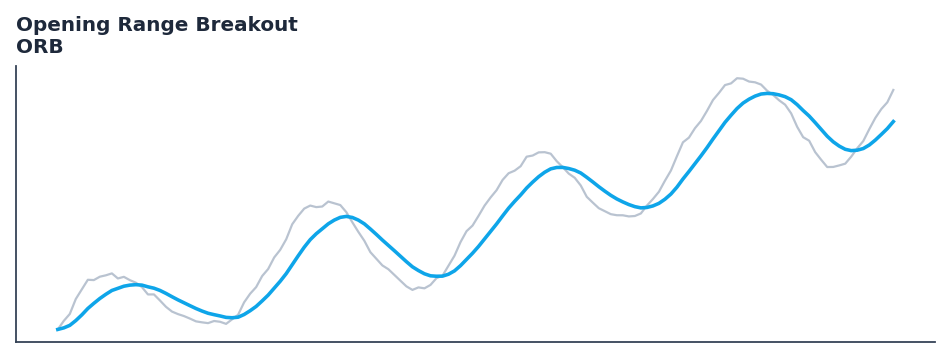
Synthetic ideal per library logic. Generated 2026-11-11 IST via docs/generate_all_previews.py (reproducible; maps to core Next<T> implementation).
Description
Tracks the high and low over the opening range bars and detects directional breakouts with extension targets.
Identifies early-session market commitment and momentum expansion. When price breaks out of the established opening range, traders enter in the direction of the break targeting 0.5x and 1.0x range extensions.
Price-action tooling with streaming and Polars batch parity. Rich outputs feed backtest signals, regime filters, and ML feature pipelines.
Pioneered by Toby Crabel in 'Day Trading with Short Term Price Patterns' (1990), Opening Range Breakout establishes support and resistance during the initial minutes of trading. A decisive breakout beyond the opening boundary often signals directional conviction for the remainder of the trading day. — Toby Crabel / TradingView
Typical applications:
- Trend filter or signal line for systematic entries
- Default lookback
15— tune per asset volatility - Cross with faster oscillator for entry timing
- Streaming and Polars paths are bit-identical for production parity
QuantWave implements this via the universal Next<T> trait — bit-identical across Rust streaming, Python streaming, and Polars .ta() batch plugins.
Formula / Specification
Implementation (session_levels):
Gold-standard parity vectors: quantwave-core/tests/gold_standard/orb.json.
Parameters
| Parameter | Default | Description |
|---|---|---|
range_bars |
15 | Number of opening bars defining the range window |
Usage Examples
Streaming (Rust)
use quantwave_core::indicators::Orb;
use quantwave_core::traits::Next;

let mut ind = Orb::new(15);
for price in &prices {
    let value = ind.next(price);
}
Streaming (Python)
Polars Batch (Python)
import polars as pl
import quantwave as qw

def apply_opening_range_breakout(series: pl.Series) -> pl.Series:
    ind = qw.Orb(15)
    return pl.Series([ind.next(float(v)) for v in series.to_list()])

df = (
    pl.read_csv('ohlcv.csv')
    .lazy()
    .with_columns(
        pl.col("close").map_batches(apply_opening_range_breakout, return_dtype=pl.Float64).alias("opening_range_breakout")
    )
    .collect()
)
All surfaces are bit-identical via the single Next<T> implementation and proptests.
Edge Cases & Limitations
- Warm-up: first
15bars may return NaN or partial state per implementation. - Parameter sensitivity: smaller periods increase noise; larger periods increase lag.
- Sudden gaps or bad ticks can distort rolling windows — consider pre-filtering.
- Single-series indicators ignore volume unless otherwise documented.
- Validated via proptests against gold-standard vectors where available.
- No look-ahead bias; streaming and Polars batch paths are bit-identical.
Boundary Behavior
| Condition | Behavior |
|---|---|
| Warm-up | Early bars return empty event lists or default structs (no scalar NaN). |
| period > len | Insufficient history yields no events rather than NaN scalars. |
| NaN inputs | NaN OHLC typically suppresses event detection for that bar. |
| Invalid params | Invalid swing_strength or tolerance raises ValueError. |
| Empty data | Empty input returns empty event collections. |
Related Indicators & See Also
Sources & References
Primary Source: https://www.tradingview.com/support/solutions/43000696950-opening-range-breakout-orb/
Implementation: quantwave-core/src/indicators/session_levels (Orb / _METADATA).
Parity: quantwave-core/tests/gold_standard/orb.json
Provenance: Standards bulk upgrade 2026-11-11 IST — see docs/DOCUMENTATION_STANDARDS.md.