Rate of Change (ROC)
A momentum-based technical indicator that measures the percentage change in price between the current price and the price n periods ago.
roc is ×100 of rocp — mixing them up is a silent 100x error
roc(N) and rocp(N) measure the same thing — the change from N bars ago — but
scale it differently, and both are valid TA-Lib functions, so nothing raises if you
reach for the wrong one:
| Function | Formula | Convention |
|---|---|---|
roc(N) |
(price / price_N - 1) * 100 |
Percent (TA-Lib convention) |
rocp(N) |
price / price_N - 1 |
Plain ratio/fraction |
Verified on the same window: roc(10) = -0.830565 vs rocp(10) = -0.008306 —
exactly 100x apart. rocp is only exposed through the TA-Lib-compatible surface
(from quantwave import talib as ta; ta.ROCP(...)), not as a native .ta. slug, so
it is easy to reach for .ta.roc() by habit and silently feed a value 100x too large
(or too small) into anything downstream — position sizing, a threshold comparison, a
feature column normalized elsewhere as a fraction. Check which convention the rest of
your pipeline expects before picking one.
See also the Agent Skill guide, which covers this and other silent-wrongness cases.
Visual Example
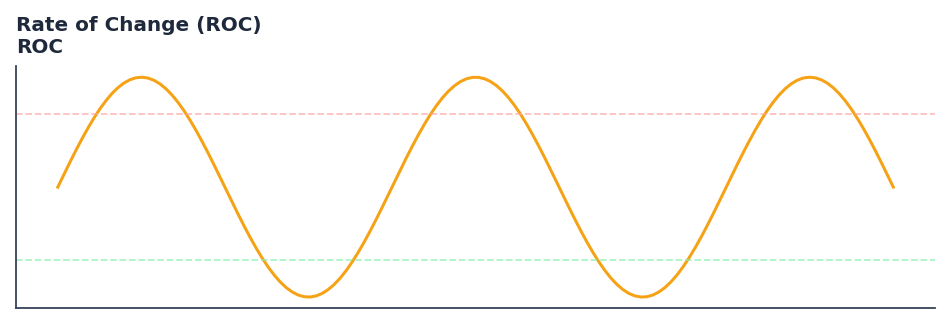
Synthetic ideal per library logic. Generated 2026-07-01 IST via docs/generate_all_previews.py (reproducible; maps to core Next<T> implementation).
Description
A momentum-based technical indicator that measures the percentage change in price between the current price and the price n periods ago.
Use to measure the speed at which price is changing. It is often used to identify overbought/oversold conditions and trend reversals.
Native Rust implementation with gold-standard or TA-Lib parity tests where applicable.
The Rate of Change (ROC) indicator is a pure momentum oscillator that measures the percentage change in price from one period to the next. It is highly effective at identifying the velocity of a move and anticipating when that velocity is slowing down. — StockCharts ChartSchool
Typical applications:
- Fade extremes in ranges; trade with trend on recoveries from oversold/overbought
- Use divergences as early warning — confirm with structure or volume
- Parameter default
10— shorten for sensitivity, lengthen for stability - Drop into
build_feature_matrix()for ML research
QuantWave implements this via the universal Next<T> trait — bit-identical across Rust streaming, Python streaming, and Polars .ta() batch plugins.
Formula / Specification
Implementation (quantwave-core/src/indicators/momentum.rs):
Gold-standard parity vectors: quantwave-core/tests/gold_standard/roc.json.
Parameters
| Parameter | Default | Description |
|---|---|---|
timeperiod |
10 | Lookback period |
Usage Examples
Streaming (Rust)
use quantwave_core::indicators::ROC;
use quantwave_core::traits::Next;

let mut ind = ROC::new(10);
for price in &prices {
    let value = ind.next(price);
}
Streaming (Python)
Polars Batch (Python)
import polars as pl
import quantwave  # registers pl.col().ta

df = (
    pl.read_csv('ohlcv.csv')
    .lazy()
    .with_columns(
        pl.col("close").ta.roc(10).alias("rate_of_change_roc")
    )
    .collect()
)
All surfaces are bit-identical via the single Next<T> implementation and proptests.
Edge Cases & Limitations
- Warm-up: first
10bars may return NaN or partial state per implementation. - Parameter sensitivity: smaller periods increase noise; larger periods increase lag.
- Sudden gaps or bad ticks can distort rolling windows — consider pre-filtering.
- Single-series indicators ignore volume unless otherwise documented.
- Validated via proptests against gold-standard vectors where available.
- No look-ahead bias; streaming and Polars batch paths are bit-identical.
Boundary Behavior
| Condition | Behavior |
|---|---|
| Warm-up | Leading bars return NaN until warmup_bars is satisfied. |
| period > len | When period exceeds series length, output is all NaN. |
| NaN inputs | NaN in input propagates to output (NaN out). |
| Invalid params | Non-positive period or missing required params raise ValueError. |
| Empty data | Empty input returns an empty result series. |
Related Indicators & See Also
Sources & References
Primary Source: https://www.investopedia.com/terms/r/rateofchange.asp
Implementation: quantwave-core/src/indicators/momentum.rs (ROC / ROC_METADATA).
Parity: quantwave-core/tests/gold_standard/roc.json
Provenance: Standards bulk upgrade 2026-07-01 IST — see docs/DOCUMENTATION_STANDARDS.md.