Average True Range
ATR represents the average of true ranges over a specified period.
Two different ATRs live under this name — check which one you are calling
atr is not a single formula in QuantWave. Surfaces split as follows, and
the two groups disagree by a materially large margin (order of a few percent at
period=14, larger on gappy data):
| Surface | Smoothing | TA-Lib / TradingView parity |
|---|---|---|
quantwave.Atr(period) streaming class |
EMA, alpha = 2/(period+1) |
No |
quantwave.atr(period, high, low, close) batch fn |
EMA, alpha = 2/(period+1) |
No |
pl.col("close").ta.atr("high", "low") Polars plugin |
Wilder RMA, alpha = 1/period |
Yes |
pl.col("high").ta.ta_atr("low", "close") |
Wilder RMA | Yes |
lf.ta().ta_atr(...) |
Wilder RMA | Yes |
quantwave.talib.ATR(...) |
Wilder RMA | Yes |
If you want the conventional ATR — the one Wilder defined in 1978 and the one
TA-Lib, TradingView Pine ta.atr, and pandas.ewm(alpha=1/period, adjust=False)
all compute — use ta_atr. The EMA-smoothed variant additionally has no NaN
warmup and is seeded from the first bar's high - low, so early values are
biased low relative to a Wilder ATR.
This matters disproportionately because ATR feeds stop distance and volatility-targeted position sizing: the error propagates straight into risk.
No authoritative source has been recorded for the EMA-smoothed variant — the
formula_source recorded for this indicator (Investopedia) describes Wilder's
RMA. The default has not been changed, because
doing so would move every ATR-composed indicator's output.
Discover this programmatically rather than trusting prose:
import quantwave as qw

for note in qw.conventions("atr"):
    print(note.aspect, "->", note.convention)
    print("differs from:", note.differs_from)
    print("guidance:", note.guidance)

qw.convention_slugs()   # every indicator carrying a convention divergence
Indicators that compose the EMA-smoothed Atr and therefore inherit the
divergence: supertrend, keltner,
atr_ts, ttm_squeeze,
vpn, plus the sr_monitor ATR field and the
volatility-clustering regime model.
Visual Example
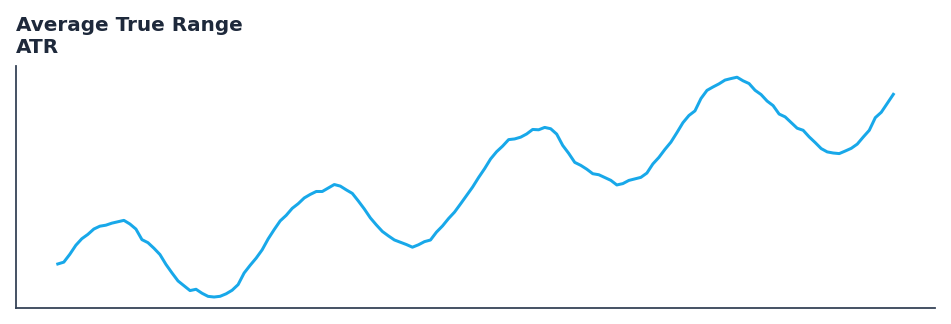
Synthetic ideal per library logic. Generated 2026-07-01 IST via docs/generate_all_previews.py (reproducible; maps to core Next<T> implementation).
Description
ATR represents the average of true ranges over a specified period.
Use as the foundational volatility module providing ATR, True Range, and related volatility measures used by higher-level indicators such as SuperTrend and Keltner Channels.
Native Rust implementation with gold-standard or TA-Lib parity tests where applicable.
Average True Range, developed by J. Welles Wilder in New Concepts in Technical Trading Systems (1978), measures the average of the true range over N bars. True Range accounts for overnight gaps by taking the maximum of: current high minus low, current high minus prior close, prior close minus current low. It remains the industry standard raw volatility measure.
Typical applications:
- Size stops and position risk from band width or ATR expansion
- Detect squeeze conditions (narrow bands) before breakout systems
- Warm-up: first
14bars build rolling volatility state - Combine with trend direction (SuperTrend, MACD) for breakout bias
QuantWave implements this via the universal Next<T> trait. Unlike every other
indicator in the catalog, atr is not bit-identical across surfaces — see the
callout above. ta_atr is bit-identical across Rust streaming, Python streaming,
and the Polars .ta() plugin, and is parity-tested against talib_rs by proptest.
Formula / Specification
True range is common to both variants:
Atr / atr() — EMA smoothing (quantwave-core/src/indicators/volatility.rs,
struct ATR):
seeded with \(ATR_0 = H_0 - L_0\), emitting a value from the first bar (no NaN warmup).
ta_atr — Wilder's RMA, TA-Lib compatible
(quantwave-core/src/indicators/incremental/ta_atr.rs, struct TaATR):
emitting NaN until n true ranges have accumulated.
Parity for ta_atr is enforced by proptest against talib_rs::volatility::atr.
There is no gold-standard vector file for the EMA variant (the metadata references
atr.json, which does not exist); its behaviour is pinned by
tests/python/test_conventions.py instead.
Parameters
| Parameter | Default | Description |
|---|---|---|
period |
14 | Smoothing period |
Usage Examples
Streaming (Rust)
use quantwave_core::indicators::ATR;
use quantwave_core::traits::Next;

let mut ind = ATR::new(14);
for price in &prices {
    let value = ind.next(price);
}
Streaming (Python)
Polars Batch (Python)
import polars as pl
import quantwave as qw

def apply_average_true_range(series: pl.Series) -> pl.Series:
    ind = qw.ATR(14)
    return pl.Series([ind.next(float(v)) for v in series.to_list()])

df = (
    pl.read_csv('ohlcv.csv')
    .lazy()
    .with_columns(
        pl.col("close").map_batches(apply_average_true_range, return_dtype=pl.Float64).alias("average_true_range")
    )
    .collect()
)
All surfaces are bit-identical via the single Next<T> implementation and proptests.
Edge Cases & Limitations
- Warm-up: first
14bars may return NaN or partial state per implementation. - Parameter sensitivity: smaller periods increase noise; larger periods increase lag.
- Sudden gaps or bad ticks can distort rolling windows — consider pre-filtering.
- Single-series indicators ignore volume unless otherwise documented.
- Validated via proptests against gold-standard vectors where available.
- No look-ahead bias; streaming and Polars batch paths are bit-identical.
Boundary Behavior
| Condition | Behavior |
|---|---|
| Warm-up | Leading bars return NaN until warmup_bars is satisfied. |
| period > len | When period exceeds series length, output is all NaN. |
| NaN inputs | NaN in input propagates to output (NaN out). |
| Invalid params | Non-positive period or missing required params raise ValueError. |
| Empty data | Empty input returns an empty result series. |
Related Indicators & See Also
Sources & References
Primary Source: https://www.investopedia.com/terms/a/atr.asp
Implementation: quantwave-core/src/indicators/volatility.rs (ATR / ATR_METADATA).
Parity: quantwave-core/tests/gold_standard/atr.json
Provenance: Standards bulk upgrade 2026-07-01 IST — see docs/DOCUMENTATION_STANDARDS.md.