VossPredictor
A predictive filter with negative group delay for band-limited signals.
Visual Example
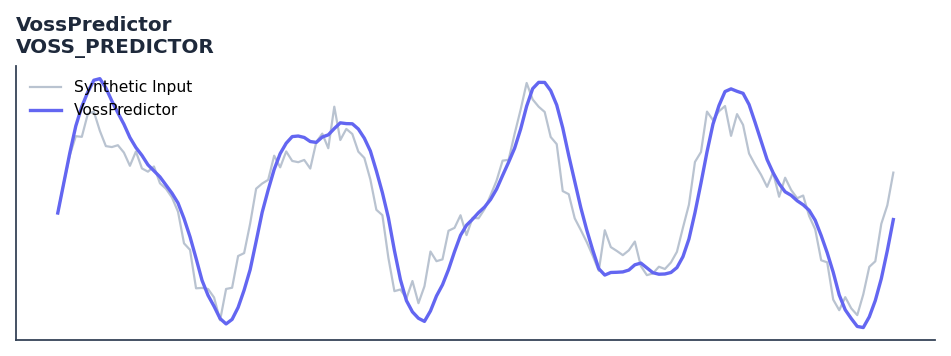
Synthetic ideal per library logic. Generated 2026-07-01 IST via docs/generate_all_previews.py (reproducible; maps to core Next<T> implementation).
Description
A predictive filter with negative group delay for band-limited signals.
Use for multi-bar price prediction based on a bandpass-filtered dominant cycle. More accurate than simple linear extrapolation due to its IIR filter pole placement.
Part of QuantWave's Ehlers digital signal processing suite. Designed for low-lag cycle and trend work — pair with Roofing Filter or SuperSmoother on noisy inputs.
The Voss Predictor is a predictive filter developed by J.F. Voss and adapted by Ehlers in Cycle Analytics for Traders. Its IIR bandpass design inherently extrapolates the filtered signal several bars into the future by virtue of pole placement inside the unit circle, enabling lookahead without buffer access.
Typical applications:
- Use for cycle timing in mean-reverting regimes
- Gate with Hurst exponent or ADX before taking cycle signals
- Allow
20+ bars warm-up for filter state to stabilise - Chain with Roofing Filter when input is noisy
QuantWave implements this via the universal Next<T> trait — bit-identical across Rust streaming, Python streaming, and Polars .ta() batch plugins.
Formula / Specification
Implementation (quantwave-core/src/indicators/voss_predictor.rs):
[ Filt = \text{BandPass}(Price, Period, 0.25) ] [ Order = 3 \cdot Predict ] [ SumC = \sum_{n=0}^{Order-1} \frac{n+1}{Order} Voss_{t-(Order-n)} ] [ Voss = \frac{3 + Order}{2} Filt - SumC ]
Gold-standard parity vectors: quantwave-core/tests/gold_standard/voss_predictor.json.
Parameters
| Parameter | Default | Description |
|---|---|---|
period |
20 | Center period of the BandPass filter |
predict |
3 | Number of bars of prediction |
Usage Examples
Streaming (Rust)
use quantwave_core::indicators::VOSS_PREDICTOR;
use quantwave_core::traits::Next;

let mut ind = VOSS_PREDICTOR::new(20);
for price in &prices {
    let value = ind.next(price);
}
Streaming (Python)
from quantwave import VOSS_PREDICTOR

ind = VOSS_PREDICTOR(20)
for price in prices:
    value = ind.next(price)
Polars Batch (Python)
import polars as pl
import quantwave as qw

def apply_vosspredictor(series: pl.Series) -> pl.Series:
    ind = qw.VOSS_PREDICTOR(20)
    return pl.Series([ind.next(float(v)) for v in series.to_list()])

df = (
    pl.read_csv('ohlcv.csv')
    .lazy()
    .with_columns(
        pl.col("close").map_batches(apply_vosspredictor, return_dtype=pl.Float64).alias("vosspredictor")
    )
    .collect()
)
All surfaces are bit-identical via the single Next<T> implementation and proptests.
Edge Cases & Limitations
- Recursive DSP filters require a warm-up period; first N bars may be unstable or raw-pass-through.
- Designed for cyclic/mean-reverting regimes; trending markets can produce lag or drift.
- Parameter
period(or equivalent) controls cutoff — too small adds noise, too large adds lag. - Prefer chaining with other Ehlers tools (Roofing Filter, SuperSmoother) on noisy inputs.
- Validated via proptests against gold-standard vectors where available.
- No look-ahead bias; suitable for live streaming and batch feature pipelines.
Boundary Behavior
| Condition | Behavior |
|---|---|
| Warm-up | Leading bars return NaN until warmup_bars is satisfied. |
| period > len | When period exceeds series length, output is all NaN. |
| NaN inputs | NaN in input propagates to output (NaN out). |
| Invalid params | Non-positive period or missing required params raise ValueError. |
| Empty data | Empty input returns an empty result series. |
Related Indicators & See Also
Sources & References
Primary Source: https://github.com/lavs9/quantwave/blob/main/references/Ehlers%20Papers/A%20PEEK%20INTO%20THE%20FUTURE.pdf
Implementation: quantwave-core/src/indicators/voss_predictor.rs (VOSS_PREDICTOR / VOSS_PREDICTOR_METADATA).
Parity: quantwave-core/tests/gold_standard/voss_predictor.json
Provenance: Standards bulk upgrade 2026-07-01 IST — see docs/DOCUMENTATION_STANDARDS.md.