Moving Average Convergence Divergence (MACD)
Gerald Appel's trend-momentum system — MACD line, signal line, and histogram in one struct, TA-Lib parity guaranteed.
Visual Example
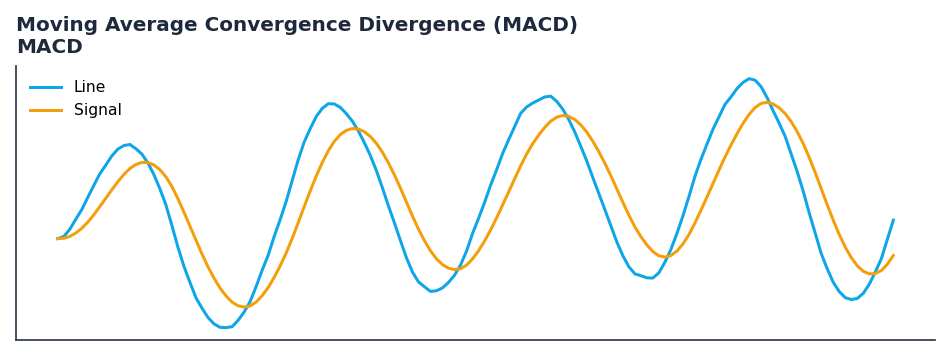
Synthetic price with MACD line, signal, and histogram. Generated via docs/generate_all_previews.py.
Description
MACD plots the difference between fast and slow EMAs (default 12 vs 26). A signal line (EMA of MACD, default 9) smooths the oscillator; the histogram (MACD − Signal) shows momentum acceleration.
Production uses:
- Signal crossovers — MACD crosses above signal → bullish momentum shift (confirm with trend)
- Histogram slope — rising histogram confirms strengthening trend; shrinking histogram warns of exhaustion
- Zero-line context — MACD above zero supports long bias on higher timeframes
- ML features — struct output (
macd,signal,hist) drops cleanly into feature matrices
QuantWave uses TA-Lib-aligned EMA seeding in incremental/macd.rs. Streaming returns (macd, signal, hist); Polars .ta.macd() returns the same struct. Proptests assert parity against talib_rs::momentum::macd.
Formula / Specification
Source: Gerald Appel (1970s); Investopedia MACD
[ \text{MACD}t = EMA(C)t - EMA(C)t ] [ \text{Signal}_t = EMA)_t ] [ \text{Hist}_t = \text{MACD}_t - \text{Signal}_t ]}(\text{MACD
Defaults: fast = 12, slow = 26, signal = 9.
Implementation: quantwave-core/src/indicators/incremental/macd.rs
Gold-standard vectors: quantwave-core/tests/gold_standard/macd.json
Parameters
| Parameter | Default | Description |
|---|---|---|
fastperiod |
12 | Fast EMA length |
slowperiod |
26 | Slow EMA length |
signalperiod |
9 | Signal EMA length |
Faster settings increase whipsaws; slower settings lag turning points. PPO offers a percentage-scaled variant for cross-asset comparison.
Usage Examples
Polars batch (recommended)
import polars as pl
import quantwave  # registers pl.col().ta

df = (
    pl.read_csv("ohlcv.csv")
    .lazy()
    .with_columns(
        pl.col("close").ta.macd(12, 26, 9).alias("macd_struct")
    )
    .with_columns(
        pl.col("macd_struct").struct.field("macd").alias("macd"),
        pl.col("macd_struct").struct.field("signal").alias("macd_signal"),
        pl.col("macd_struct").struct.field("hist").alias("macd_hist"),
    )
    .collect()
)
Streaming (Python)
import quantwave as qw

macd = qw.streaming_class("macd")(fastperiod=12, slowperiod=26, signalperiod=9)
for price in closes:
    out = macd.next(price)  # macd, signal, hist
Streaming (Rust)
use quantwave_core::indicators::MACD;
use quantwave_core::traits::Next;

let mut macd = MACD::new(12, 26, 9);
for price in &closes {
    let (line, signal, hist) = macd.next(*price);
}
Signal wiring (crossover)
Edge Cases & Limitations
- Range markets: Frequent signal-line crossovers without trend — gate with ADX or SuperTrend.
- Warm-up: Needs
slowperiod + signalperiodbars for stable signal EMA. - Lag: Inherent to EMA construction; Ehlers tools (Cyber Cycle) offer lower-lag alternatives for timing.
- Single price input: Volume-less; combine with MFI or OBV for flow confirmation.
Boundary Behavior
| Condition | Behavior |
|---|---|
| Warm-up | Leading bars return NaN triple until EMAs seed. |
slowperiod > series length |
Insufficient data → NaN outputs. |
| NaN in close | NaN propagates through EMA chain. |
| Invalid params | Non-positive periods raise ValueError. |
Related Indicators & See Also
- PPO — percentage-scaled MACD for cross-asset ranks
- RSI — complementary momentum oscillator
- APO — MACD without signal line
- Multi-Indicator Analysis notebook
Sources & References
Primary source: Appel; Investopedia MACD
Implementation: quantwave-core/src/indicators/incremental/macd.rs (MACD / MACD_METADATA)
Parity: TA-Lib proptest in momentum.rs; gold-standard macd.json