MarketState
Identifies trend vs cycle regimes using Correlation Cycle phase angle.
Visual Example
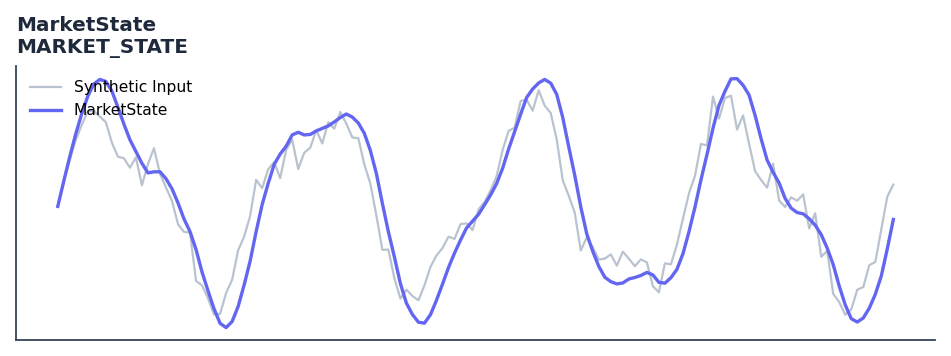
Synthetic ideal per library logic. Generated 2026-07-01 IST via docs/generate_all_previews.py (reproducible; maps to core Next<T> implementation).
Description
Identifies trend vs cycle regimes using Correlation Cycle phase angle.
Returns 1 for uptrend, -1 for downtrend, and 0 for cycle mode. Use to switch between trend-following and mean-reversion strategies.
Part of QuantWave's Ehlers digital signal processing suite. Designed for low-lag cycle and trend work — pair with Roofing Filter or SuperSmoother on noisy inputs.
In 'Correlation As A Cycle Indicator' (2020), Ehlers defines a Market State variable based on the rate of change of the Correlation Cycle phase angle. When the angle changes slowly (less than 9 degrees per bar), the market is in a trend regime (positive angle for uptrend, negative for downtrend). Rapid angle changes indicate a cycle regime.
Typical applications:
- Use for cycle timing in mean-reverting regimes
- Gate with Hurst exponent or ADX before taking cycle signals
- Allow
14+ bars warm-up for filter state to stabilise - Chain with Roofing Filter when input is noisy
QuantWave implements this via the universal Next<T> trait — bit-identical across Rust streaming, Python streaming, and Polars .ta() batch plugins.
Formula / Specification
Implementation (quantwave-core/src/indicators/market_state.rs):
Gold-standard parity vectors: quantwave-core/tests/gold_standard/market_state.json.
Parameters
| Parameter | Default | Description |
|---|---|---|
period |
14 | Correlation wavelength |
threshold |
9.0 | Angle rate of change threshold for trend detection |
Usage Examples
Streaming (Rust)
use quantwave_core::indicators::MARKET_STATE;
use quantwave_core::traits::Next;

let mut ind = MARKET_STATE::new(14);
for price in &prices {
    let value = ind.next(price);
}
Streaming (Python)
from quantwave import MARKET_STATE

ind = MARKET_STATE(14)
for price in prices:
    value = ind.next(price)
Polars Batch (Python)
import polars as pl
import quantwave as qw

def apply_marketstate(series: pl.Series) -> pl.Series:
    ind = qw.MARKET_STATE(14)
    return pl.Series([ind.next(float(v)) for v in series.to_list()])

df = (
    pl.read_csv('ohlcv.csv')
    .lazy()
    .with_columns(
        pl.col("close").map_batches(apply_marketstate, return_dtype=pl.Float64).alias("marketstate")
    )
    .collect()
)
All surfaces are bit-identical via the single Next<T> implementation and proptests.
Edge Cases & Limitations
- Recursive DSP filters require a warm-up period; first N bars may be unstable or raw-pass-through.
- Designed for cyclic/mean-reverting regimes; trending markets can produce lag or drift.
- Parameter
period(or equivalent) controls cutoff — too small adds noise, too large adds lag. - Prefer chaining with other Ehlers tools (Roofing Filter, SuperSmoother) on noisy inputs.
- Validated via proptests against gold-standard vectors where available.
- No look-ahead bias; suitable for live streaming and batch feature pipelines.
Boundary Behavior
| Condition | Behavior |
|---|---|
| Warm-up | Leading bars return NaN until warmup_bars is satisfied. |
| period > len | When period exceeds series length, output is all NaN. |
| NaN inputs | NaN in input propagates to output (NaN out). |
| Invalid params | Non-positive period or missing required params raise ValueError. |
| Empty data | Empty input returns an empty result series. |
Related Indicators & See Also
Sources & References
Primary Source: https://www.traders.com/Documentation/FEEDbk_docs/2020/06/TradersTips.html
Implementation: quantwave-core/src/indicators/market_state.rs (MARKET_STATE / MARKET_STATE_METADATA).
Parity: quantwave-core/tests/gold_standard/market_state.json
Provenance: Standards bulk upgrade 2026-07-01 IST — see docs/DOCUMENTATION_STANDARDS.md.