Reflex
A zero-lag averaging indicator that synchronizes with the cycle component by measuring the reflex (difference) between a SuperSmoother and its linearly projected historical values.
Visual Example
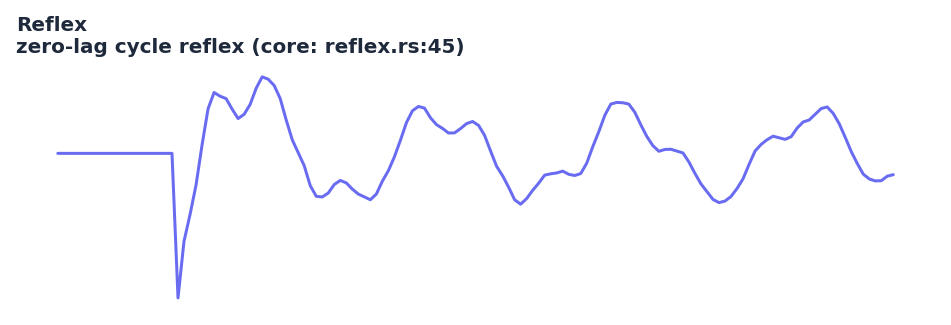
Synthetic ideal cyclic price series engineered to produce clear zero-crossings at cycle extrema. Matches the exact SuperSmoother(period/2) + slope projection + RMS normalization logic in quantwave-core/src/indicators/reflex.rs (Nextdocs/gen_indicator_previews.py.
Description
Reflex is designed to give the earliest possible indication of a cyclic reversal while remaining smooth. It first applies a SuperSmoother (with period = length/2) to suppress noise, then computes a linear slope projection from the current smoothed value back length bars, and measures the cumulative "reflex" (difference) between the actual smoothed history and that straight-line projection. The result is normalized by a running RMS estimate to produce a zero-centered oscillator that leads price turns.
It is more responsive to genuine cycle turns than a plain moving average or even the Cyber Cycle in many regimes, but like all Ehlers tools it assumes the presence of a dominant cycle. In strong trends the output tends to stay on one side of zero for extended periods. Use in conjunction with a trend-strength or regime filter (Cyber Cycle momentum, market structure bias, or ADX) for best results. The indicator is fully causal and participates in the universal parity guarantee.
Formula / Specification
Exact implementation in QuantWave (quantwave-core/src/indicators/reflex.rs):
- Compute
Filt = SuperSmoother(price, length/2)(internal stateful smoother). - Maintain a history of the last
length+1filtered values. - After sufficient history, compute the slope over the full lookback:
slope = (Filt_{t-length} − Filt_t) / length. - Compute the average reflex
Sum = (1/length) Σ (Filt_t + n·slope − Filt_{t-n})for n = 1…length. - Update a smoothed mean-square:
MS = 0.04·Sum² + 0.96·MS_{t−1}. - Output
Reflex = Sum / √MS(or 0 when MS is near zero). - The streaming
Next<f64>and the proptest reference batch implementation (reproducing the identical smoother + history + slope math) are bit-identical (approx1e-10).
Parameters
| Parameter | Default | Description |
|---|---|---|
length |
20 | Assumed cycle period. The internal SuperSmoother uses length/2; the reflex lookback and slope projection use the full length. |
Usage Examples
Streaming (Rust)
use quantwave_core::indicators::Reflex;
use quantwave_core::traits::Next;

let mut reflex = Reflex::new(20);
for price in price_series {
    let r = reflex.next(price);
    if r > 0.8 { /* strong bullish reflex */ }
}
Streaming (Python)
Polars Batch (Python — primary research / feature surface)
import polars as pl
import quantwave as qw

def reflex_expr(col: str, length: int = 20):
    r = qw.Reflex(length)
    def _apply(s: pl.Series) -> pl.Series:
        return pl.Series([r.next(float(v)) for v in s.to_list()])
    return pl.col(col).map_batches(_apply, return_dtype=pl.Float64)

df = (
    pl.read_csv("ohlcv.csv")
    .lazy()
    .with_columns([reflex_expr("close", 20).alias("reflex")])
    .collect()
)
All surfaces share the identical Next<f64> implementation; parity is proven by the proptest in reflex.rs.
Edge Cases & Limitations
- Returns 0.0 during the first
lengthbars (insufficient history for the slope/reflex calculation). - In strong persistent trends the indicator can remain away from zero for long runs; it is not a mean-reversion oscillator.
- The internal SuperSmoother period is hard-coded to
length/2per the original design; changing the outer length also changes the smoother. - MS can underflow or become extremely small in very quiet periods, producing unstable division (guarded by the implementation).
- Sensitive to the assumed cycle length; a length that is far from the true dominant cycle reduces leading character.
- Best paired with a regime gate (e.g. only take Reflex zero-cross signals when Cyber Cycle momentum is high and market structure bias agrees).
- No look-ahead bias.
Boundary Behavior
| Condition | Behavior |
|---|---|
| Warm-up | Leading bars return NaN until warmup_bars is satisfied. |
| period > len | When period exceeds series length, output is all NaN. |
| NaN inputs | NaN in input propagates to output (NaN out). |
| Invalid params | Non-positive period or missing required params raise ValueError. |
| Empty data | Empty input returns an empty result series. |
Related Indicators & See Also
- Cyber Cycle — companion cycle oscillator; use together for regime confirmation
- UltimateSmoother and Super Smoother — building blocks
- Trendflex — the trend counterpart in the same 2020 TradersTips article
- Ehlers Stochastic — another zero-lag cycle tool from the Ehlers family
- Market Structure — confirm bias before acting on Reflex crosses
- Indicator Gallery • Native Indicators
- See Ehlers 2020 Traders' Tips article for the original EasyLanguage reference.
Sources & References
Primary Source: quantwave-core/src/indicators/reflex.rs (REFLEX_METADATA + Next
Visual: Generated 2026-05-31 IST via docs/gen_indicator_previews.py.
Additional Context: Ehlers, Cycle Analytics for Traders (2013) for the broader context of zero-lag techniques and the importance of matching the assumed cycle length to market conditions.
Implementation Provenance: Universal Next<T> contract and batch/streaming parity in quantwave-core/src/traits.rs and the proptest inside reflex.rs.